Tuesday, June 11, 2013
"These Are the People Who Actually Did the Work"
Monday, November 16, 2009
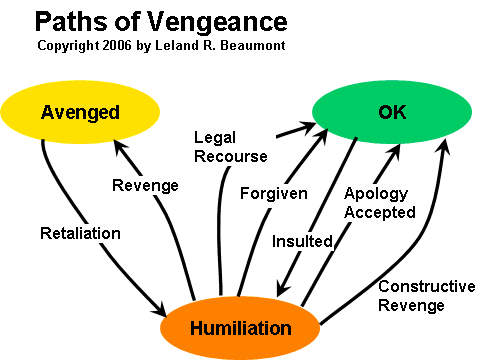
Revenge is sweet
I was laughed off the blog. My scientific credentials and ethical values were challenged. The comments were very reactionary, not very scientific.
Six months later, and my how things have changed. The phenomenon I predicted was borne out in major studies. I heard doctors talking about it on NPR. Now, in recognition of these new findings, it looks like the recommended age for mammography may soon change from 40 to 50.
A lot of bloggers call themselves "skeptics" because they dare to mock other peoples' beliefs. But that's not what science is about. Science is about creativity and challenge, not biology-textbook dogma. It's about thinking outside of the box. From that perspective, I daresay some of these science bloggers could learn a thing or two from the people they are mocking.
Sunday, October 25, 2009
Talkin' politics
----------------
Hey [Friend in Israel], thanks for the e-mail, I appreciate your genuine interest. I do try to be intellectually honest.
So far, I've listened only to the first video (about Hitler, WWII). I think these arguments do hold some water. In particular, I agree with the speaker's central thesis - that diplomacy frequently fails to bring peace. However, I think the speaker is not sufficiently critical of war, which often fails as well (often at tremendous cost).
... The main problem with the video is that it only considers only two options: diplomacy (by politicians), or war. Neither option is very effective in my opinion. This is characteristic of Western thought these days - very polarized, not very creative.
There is a third option - one that has been largely forgotten even by the left. That option is non-violent resistance. It is the way of Ghandi and Martin Luther King, both of whom led tremendously successful social movements post-WW2. Non-violence does not mean non-action. It means active protest without resorting to violence. In theory, this helps you win the enemy's hearts and minds by getting them to think and respect you. If you are interested in learning how it works, I suggest you read two books:
1. The Autobiography of Martin Luther King Jr., by Clayborne Carson
--this is a collection of MLK's writings and speeches, chronicling his civil rights days through his opposition to Vietnam
2. Ghandi: an Autobiography; the Story of My Experiments With Truth
--penned by Ghandi himself, it goes into depth about his early upbringing and his philosophies of non-violence and experimentation
A common denominator to these two fellows is that they were raised very religious, although in two different faiths, and both men drew from their faiths to arrive at the principle of non-violence. I can relate to this; when I memorized Pirkei Avot over ten years ago, the many sayings about peace, wisdom, and relationships planted the seeds of this philosophy in my mind, well before I read any of the above.
I think there are other ways to wage peace besides non-violent resistance, but you really have to get creative. This creativity is what's missing from our leaders these days. I do not trust them one lick - they are old fools, and one is worse than the next. I would not follow them into battle, or rely on them to make peace through diplomatic means.
Hope this gives you something to think about! Let me know if you have any specific responses to what I've said. Take care and always fun to talk politics with you.
Samurai
PS Have you ever seen Watchmen? Or read the graphic novel? It gets into a lot of these questions. You might like where it ends up.
Tuesday, September 22, 2009
Curing color blindness, and color vision
Turning to color blindness of a different sort, I recently had an interesting facebook conversation about the hidden hand of race in our society. I was not alone amongst my friends (or the media/politicians) in detecting a hint of racism in the GOP of late. From the "fiery latina" bullshit that surrounded the Sotomayor hearings (white males are the victims of racism!) to Joe Wilson's shameful "You lie!", there's something more than a healthy fear of socialism going on around here.
Most agreed, but one friend felt I'd mistaken partisan politics for racism, and certainly it's difficult to prove. After all, no one wants to be a racist, and even fewer want to be labeled one. In this emotionally charged arena, science is really our best hope of understanding what is really going on. As another friend pointed out, there is a burgeoning field of research on implicit racism, which distinguishes between overt racism and less conscious racism and predicts that people with implicit biases act equally in cut and dry situations, but act very biasedly in ambiguous situations.
One set of recent experiments showed that people pause just a fraction of a second longer before identifying opposite-race faces as friendly. Other research has revealed that schoolchildren have a tendency to self-segregate, suggesting that racism is to some extent a natural tendency (the tribe instinct?). There's some great stuff about this in a recent Newsweek cover story, including this hilarious excerpt about an experiment observing classroom children:
It being December, the teachers had decided to read to their classes 'Twas the Night B'fore Christmas... As the teachers began reading, the kids were excited by the book's depiction of a family waiting for Santa to come. A few children, however, quietly fidgeted. They seemed puzzled that this storybook was different: in this one, it was a black family all snug in their beds.
Then there was the famed clatter on the roof. The children leaned in to get their first view of Santa and the sleigh as Johnson turned the page—
And they saw that Santa was black.
"He's black!" gasped a white little girl.
A white boy exclaimed, "I thought he was white!"
Immediately, the children began to chatter about the stunning development. At the ripe old ages of 6 and 7, the children had no doubt that there was a Real Santa. Of that they were absolutely sure. But suddenly there was this huge question mark. Could Santa be black? And if so, what did that mean?
It may yet prove easier to cure color blindness in our eyes than to unlearn "color vision" in our hearts. But if there's a cure to this societal disease, it lies in every next generation. We have to talk to our children, integrate them socially, and be honest about our own implicit biases - when in doubt, letting science be our guide.

Tuesday, August 11, 2009
A shortcut to curing human disease
"Medical innovations" is what surgeons call trying out new techniques on patients. It's important to keep in mind here the difference between medicine and research. As a recent Science article explains:
... What are the hallmarks of an innovative stem cell–based medical intervention? To answer this question, we have to clarify the central difference between research, as carried out in a clinical trial process, and medical innovation. As explained in the seminal U.S. research ethics document, the Belmont Report, research aims at scientifically generalizable results (not patient care), whereas the goal of medical innovation is the benefit of the individual patient. Because of these disparate aims, the regulatory requirements for clinical research do not serve as a proper surrogate for the ethical standards appropriate for attempts at medically innovative therapies. In short, the ethics of medical innovation is the ethics of patient care, not research.There is potential here for a cheapie shortcut towards curing human disease. Basic research funding is cheap and gives us detailed, scientific information. Medical innovations are cheap and let us test potential cures. If we can establish lines of communication between the two (plus reasonable ethical guidelines for their application), perhaps we can circumvent the need for prohibitively expensive clinical trials - and discover some new cures in the process.
Thursday, July 30, 2009
Did Michael Jackson's doctor KILL him?
Tuesday, July 7, 2009
Cleaning Lady
cleaning, washing, making beds,
she spoke in broken English.
I was only seven then,
I helped her learn to read;
she taught us games in broken speech,
we were her only children.
I tried to help her read, but still
she couldn’t understand. And soon
we weren’t children, didn’t need
her silly Polish games.
We mocked her, couldn’t understand
her broken English, crooked teeth;
“The stupid Pollack’s fault again,”
blaming her for everything:
the missing pen or broken lamp,
those teenage years were full of hate.
We blamed her for our own mistakes –
I led my siblings on.
Those teenage years were full of hate,
and where was she to run?
One night I led in the attack,
so cruel the words I said. . .
but where was she to run? Ten years
of cleaning, washing, making beds –
“I used,” she said with angry tears,
“to call you my professor.”
Sunday, April 19, 2009
Playing "Uncle Darwin"
Monday, March 23, 2009
Fresh Fathers: Pre-ramble
I'd like to revisit Avot, here on Samurai Scientist and/or Twitter, over the coming weeks. Traditionally, the book is studied during the seven weeks between Passover and Shavuot, so this is a good time to start. Avot lends itself easily to blog format - the pithy sayings are short and open-ended, a springboard for discussion. I hope you'll chime in.
Friday, March 20, 2009
Be Amazing!
Tuesday, March 10, 2009
Is Obama behind the times on stem cells?
Political opponents reacted by calling Obama "behind the times" on stem cells. After all, there are now ways of making ES cells without destroying embryos: